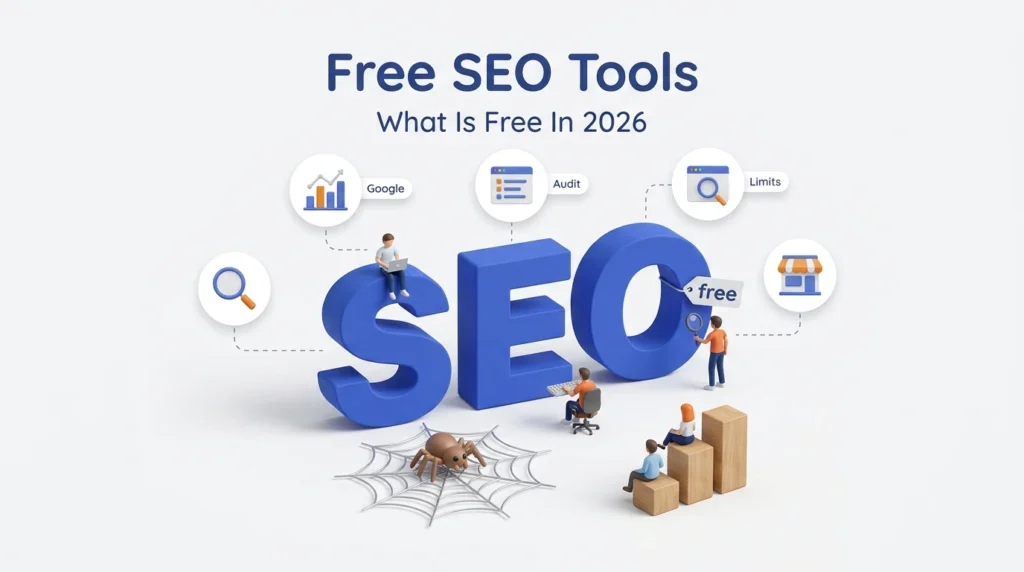
A free SEO tool is one you can use without a credit card or a time limit. The best free options cover indexing data, crawling and keyword research, but each has a cap, and the caps decide which tools belong in your stack. Here is what each free tier includes and where it stops.
What Makes an SEO Tool Free?
A tool is free only if it works without a credit card or time limit, and free trials do not count. That is a stricter test than most roundups apply. A product that lets you run one URL before asking for payment is a demo, not a free tool.
Three models get lumped together under the label:
| Model | What you get | What to check |
|---|---|---|
| Permanently free tier | Ongoing access with no expiry | Which features are held back |
| Usage cap | Free access up to a limit of URLs, keywords or reports | How often the cap resets |
| Trial | Full features for a set period | What happens when it ends |
Permanently free tiers and usage caps often overlap. A free crawler with a URL ceiling is both. Trials are different in kind, because the clock is the product. You can use one to evaluate a paid plan, but you cannot build a workflow on it.
Single-use checks need the same scrutiny. If a page audits one URL and then locks the report behind a signup or a payment, you have seen a sample. When you compare tools below, the question is always the same: can you keep using this next month, on your own site, at the volume you need?
Which Free SEO Tools Does Google Offer?
Google Search Console and Google Keyword Planner are both free to use, and they answer different questions. Search Console tells you how your site performs in Google. Keyword Planner estimates demand for terms you may not rank for yet.
“Search Console tools and reports help you measure your site’s Search traffic and performance, fix issues, and make your site shine in Google Search results.”
Search Console changed a lot in 2026, so older tutorials are partly out of date:
- February: Search Console Insights moved into the main interface, replacing the standalone beta.
- June: AI Overview reporting arrived, along with weekly and monthly trend views and Insights query groups.
- AI Mode: Data from AI Mode now counts toward the totals in the Performance report, so impressions and clicks can shift without any change on your site.
- August 12: The generative AI performance report, launched June 3 in select markets, reached all accounts.
- August 31: A new toggle lets you choose whether your site appears in and helps ground generative AI Search features such as AI Overviews and AI Mode.
The toggle is a policy decision, not a reporting setting, so decide it deliberately and record who made the call.
One more piece of guidance matters if you report to stakeholders. On November 12, Google explained why Google Analytics numbers will not match Search Console click counts and listed four sources of mismatch. Treat the two as different measurements. Do not average them or reconcile them to the click.
Keyword Planner has its own conditions. It costs nothing, but you need a Google Ads account to use it. If your account has little or no ad spend, search volume is shown as ranges rather than specific numbers. That is enough to rank terms against each other, but not enough to forecast traffic precisely.
Which Free SEO Audit Tools Are Worth Starting With?
Three free audit options are worth a look: sourceseo.ai, a B2B SEO platform that offers a free SEO audit, then Ahrefs Free and Screaming Frog’s free crawler. They differ mainly in how they count what you can scan.
Ahrefs Free gives you 5,000 crawl credits per project per month in Site Audit. The allowance resets monthly and is tied to the project, so it suits ongoing monitoring of a site. Credits are spent as the crawler fetches pages, so a large site can use up a month’s allowance in one full crawl.
Screaming Frog’s free crawler works differently. It crawls up to 500 URLs per crawl and runs on your own machine. There is no monthly meter, but there is a hard ceiling on each run.
Here is what that means in practice:
- A 300-page site: It fits inside one Screaming Frog crawl, with some room to spare. Depending on your configuration, images and scripts can count toward the 500, so a media-heavy site may come closer to the limit than the page count suggests.
- A 5,000-page site: It does not fit. A single Screaming Frog crawl covers about a tenth of it, and you would have to crawl by section. Ahrefs Free can cover more in a month, but one full crawl may take most of the allowance.
- A site that changes weekly: Monthly credits matter more than per-crawl limits, because repeat crawls draw down the same pool.
For a small site, start with a single audit, fix the errors it flags, and rerun it after changes. For a larger one, use the free tiers to sample templates, such as one category page, one product page and one article. Template-level problems repeat across thousands of URLs.
What Limits Do Other Free SEO Tools Set?
Most other free tools cap the number of checks, keywords or reports per day or month. Moz’s free SEO checkers and SE Ranking’s free tools are typical examples. Each handles one task at a time, such as looking up a single domain or keyword, and nudges you toward a paid plan for bulk work or saved history. They are useful for spot checks and poor for monitoring.
Community-recommended lists, such as forum threads and roundup posts, are a reasonable place to start looking. Treat them as a starting point rather than a verdict. The recommendations tend to reflect what someone used once, often before the tool changed its limits. Test any suggestion against your own site and see where it stops.
Free AI SEO tools follow the same pattern. Most offer a limited free tier, usually a small number of generations or analyses before a paywall. A trial is not free, so a tool that gives you full access for two weeks belongs in a different category. Check whether the free tier lets you export results, because a tool that shows output but will not let you keep it is a preview.
Data costs are also pushing limits down. Google removed the n=100 SERP parameter in September 2025, which made it more expensive for tools to collect ranking data in bulk. Some free tiers may have tightened as a result, so a limit reported in an older guide may no longer apply. Check the current signup or pricing page before you plan around any number.
How Should You Choose a Free SEO Tool Stack?
Pick one tool per job before adding more. Cover indexing and search data, crawling, and keyword research, and resist stacking three tools that do the same thing. A typical starting set is Search Console for search data, one crawler for technical checks, and Keyword Planner or a free keyword checker for demand.
Run each candidate through this checklist:
- The question: Name the decision the tool should inform. If you cannot, skip it.
- The first limit you will hit: Crawl caps, keyword counts and daily checks all bite at different points. Find yours.
- Access requirements: Does it need an ad account, a login or a verified property? Keyword Planner needs a Google Ads account, and Search Console needs site verification.
- The reader: Decide who will use the output. A developer can work from a raw crawl export, while a client may need a summary.
- The exit point: Write down the volume or frequency at which the free tier stops being enough, so the upgrade is a planned decision.
The signal that a paid plan is worth it is recurring work that exceeds the caps. If you rerun the same crawl every week and hit the ceiling every time, or you copy rankings into a spreadsheet by hand, you are already paying in hours. Until then, a small free stack, reviewed every quarter, does the job.
Frequently asked questions
Yes, several full-featured SEO audit options have free tiers, but each one caps usage. Crawl limits, project counts and monthly credits decide how much of a site you can check for free. Check the free tier's stated limits before relying on it for a large site.
The best free SEO tool depends on the job, since no single product covers crawling, search data and keyword research equally well. For technical crawling of smaller sites, a free desktop crawler is often enough. For search performance data, Google Search Console is the standard free option.
Google offers Search Console and Keyword Planner at no charge. Keyword Planner requires a Google Ads account, and low-spend accounts see keyword volume as ranges rather than exact figures. Search Console reports on your own site's clicks and impressions, not on competitors.
Some SEO AI tools offer a free tier with monthly limits on prompts, reports or site checks. A free trial that ends in a required payment does not make a tool free. Read the pricing page for the permanent free plan rather than the trial terms.

Gaurav Chaudhary
Gaurav Chaudhary oversees delivery and operations at Source Code Lab, ensuring AI agents integrate seamlessly into client workflows and scale reliably in production. His expertise spans coordinating multi-agent systems, complex enterprise integrations, and post-launch optimization across diverse industries.
See full bio and all articles