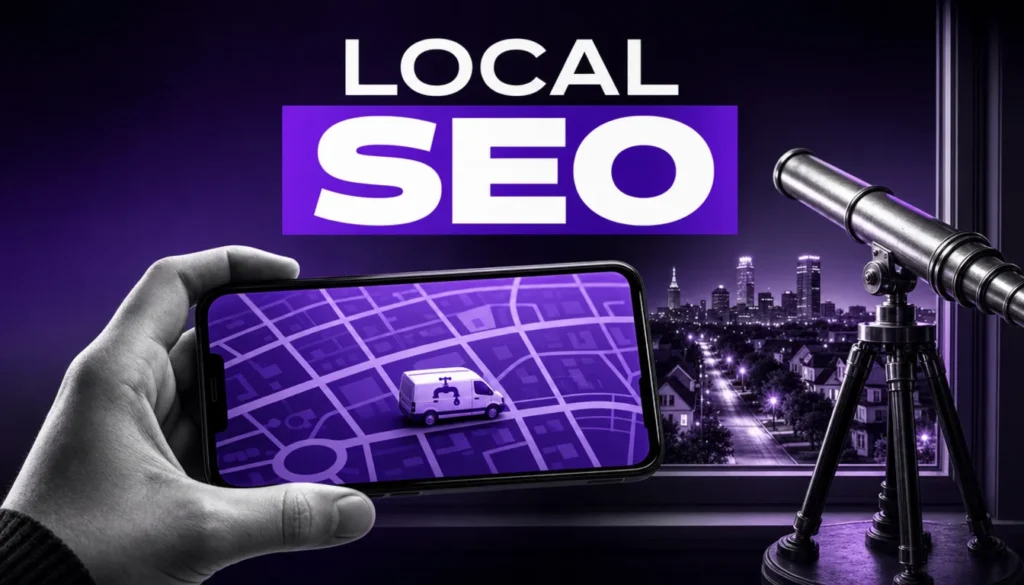
Local seo is the work of appearing in Google’s map pack and local results for place-based searches, such as “water heater repair Tulsa.” Google ranks those results on relevance, distance and prominence, and trust signals feed the third factor most directly.
What is local seo, and how do Google’s trust signals decide who ranks?
Google describes three factors. Relevance is how well a Business Profile matches the query. Distance is how far the business is from the searcher, or from the location named in the search. Prominence is how well known the business is, drawn from reviews, links, articles and directory mentions across the web.
Trust signals do most of their work inside prominence:
- A verified Business Profile. Without it, you are not competing for the map pack.
- Review volume and recency. A steady flow of recent reviews reads differently from a burst two years ago.
- Consistent name, address and phone data across directories, so Google can match the mentions to one business.
Take a hypothetical plumbing company based in Tulsa, Oklahoma, serving Tulsa County. It controls its verification, its primary category, its listed service areas, how quickly it asks for reviews, and whether its phone number reads the same on every directory. It does not control where the searcher is standing. A homeowner in Owasso and one in Bixby can search the same phrase and see different packs, because distance shifts the result. It also does not control how many reviews a competitor collects.
So the work is to maximize what you own and stop worrying about the rest. A plumber who is verified, correctly categorized and consistently listed has done everything the signals allow.
Which local seo changes in October 2026 need action now?
Most October 2026 profile changes need no action, and promotions and pricing belong on your website, not in your listing. One change does call for a clean-up this week.
“When a customer searches for a business or place near their location, they’ll find local results on Google Maps and Search.”
On October 6, Google updated its Maps and Business Profile prohibited-content policy. It now lists what merchants can’t post in listings or posts, including time-bound promotions, pricing and direct calls-to-action in listings. On October 7, Google began showing WhatsApp buttons in the local panel, in place of chat or alongside the other action buttons. On October 13 it started rolling out dietary attributes for restaurants, including gluten-free, dairy-free, halal and kosher options. Google’s September 2026 spam update, which began September 24, finished rolling out on October 8, and Google gave no Business Profile-specific guidance with it.
| Change | Date | Verdict | Tulsa plumber’s move |
|---|---|---|---|
| Prohibited-content update (promotions, pricing, direct calls-to-action) | Oct 6 | Act now | Strip “$49 drain special” or “call today” language from the description and posts. Put offers on a website page. |
| WhatsApp buttons in the local panel | Oct 7 | Check | Look at the live panel. If a button appears that you did not set up, confirm it points somewhere you monitor. |
| Restaurant dietary attributes | Oct 13 | Ignore | Not relevant to a plumber. |
| September 2026 spam update | Finished Oct 8 | Ignore | No Business Profile guidance was given. Keep doing normal, honest work. |
The plumber’s first two rows take an hour. The rest is noise for this business.
What should a local business do next for local seo?
Verify the Google Business Profile first, then fix citation mismatches. Everything else builds on those two. Work through this checklist in order:
- Profile verification. Confirm the profile is verified and that you can still log in to the owner account.
- Category and service-area accuracy. Choose the primary category that matches your main job, add secondary ones only where they are true, and list the towns and counties you actually serve.
- Review requests within days. Ask after each completed job, while the customer remembers it. For the Tulsa plumber, that means a text the same week as the repair.
- One location page per service area. Name the towns and the county on each page, such as Jenks or Broken Arrow in Tulsa County, and write about work you have done there. Skip near-duplicate pages with only the town swapped.
- A monthly check. Look for wrong hours, changed categories and edits suggested by others. Profiles drift.
Two references are worth bookmarking. Read the Google Business Profile guidelines before editing anything that touches your description or posts. Use the Google Search Status Dashboard to confirm when an update has actually finished rolling out before you change anything in response.
Frequently asked questions
Local seo is the practice of making a business appear in Google's map pack and local organic results when a searcher includes a place or uses a near-me phrase. It depends on a verified Google Business Profile, consistent business details across directories, and location-specific pages on the business website. Results are shaped by how well the business matches the query, how far it sits from the searcher, and how prominent it is online.
Local searches often lead to a call, a direction request or a visit within a day, so visibility in the local results translates into nearby customers. A business that ranks well nationally can still be absent from local results if its profile is weak. Local listings also show phone buttons, directions and reviews, letting a searcher act without visiting the business website.
Start by claiming and verifying the Google Business Profile, then make the business name, address and phone number match exactly on the website and on major directories. Create a separate page for each service area with accurate local details such as town and county names. Ask customers for reviews within a few days of a completed job, and check the profile each month for wrong categories or hours.
Improvement usually comes from closing gaps competitors leave open, such as unanswered reviews, missing service categories or a profile with no new photos in the past quarter. Track calls, direction requests and website clicks from the profile instead of relying only on ranking positions. Keep promotions and prices on the business website, because Google's Maps and Business Profile policy updated on October 6, 2026 prohibits time-bound promotions, pricing and direct calls-to-action in listings.
A citation is any online mention of a business's name, address and phone number, typically on a directory, data aggregator or industry site. Consistent citations help Google confirm that the business exists at the address it claims. Conflicting versions, such as an outdated suite number on one directory, can weaken the profile's credibility.

Amit S. Maurya
Amit S. Maurya is the SEO Manager at SourceSEO, managing search visibility strategies across dozens of client websites. With hands-on experience auditing and optimizing sites across competitive industries, he specializes in technical SEO, content strategy and ranking optimization. Amit understands the gap between an SEO audit and actual implementation—he lives it every day.
See full bio and all articles